Video Categories

Step 5: Sharpen Side bevels
Subscribing members can download here a PDF with notes for this lesson and a crib sheet of the various steps to have beside you while you work.

Charlie - It's rare these days of well-established, good quality carving tools to have that sort of problem with soft metal. I'd go for the outside bevel being too long. With a gouge, but also with a V tool you add inside bevel to toughen up a low angled cutting edge (which is what we want).

Thank you Chris. I've not ever used an Inside Bevel, but I'll get there with these excellent video series.

Charlie, I had the exact same thing happen to me last night when i attempted to sharpen my Henry Taylor V-tool. I was glad to see this wasn't some strange phenomenon that only I had encountered. I was as if the egde turned to tin foil at the very end/cutting tip. I gather this is due to, as Chris said, the low cutting angle, but also excessive sharpening. In other words, I probably continued sharpening moving through the various grits I use but by the time I got the the last one the cutting edge was so thin it turned to flakey/tin foil type metal, which was hard to work with and is not easily matched by the other side of the V. Will be taking another stab at it today after brushing up on this awesome video series.

Charlie & Joseph - Yes, do keep at it. Sharpening is a skill and we learn skills by trial and error. If something isn't right, see if you can work out what you might be doing to reach that result and try something different. It's only a piece of metal and, in my book, if you wear a tool down to nothing learning how to get it correctly sharp, it's well worth it in terms of the joy of using it and the satisfaction you'll reap in your carving. Hopefully THAT won't happen!

I've had two failures on different brands of v-tool. The first was from very old German manufacturer. #39/12. Beautiful, thick, polished steel. The second a good english brand. On the first, I got a notch in the apex just after the white dot disappeared and I was testing it in a scrap. With the english tool, 60 degree 5/16ths. I got it sharp, but snapped off a crescent just above the apex on one side. This was just running a simple v groove in basswood. Neither have inside bevels. The German tool problem happened some time back and, like Charlie, I could get a tolerable edge by raising the bevel. I don't think you had yet posted about an inside bevel on the v-tool. The english tool problem happened today. The metal must just be too thin at my 17 degree cutting angle. I know how to put an inside bevel on the chisel parts, but on the apex all I have to get that deep is an Arkansas v-tool stone with a fairly sharp edge. I think I can eventually (and carefully) get a inside bevel on the apex with that. Do you use the same 10 degree bevel as on a gouge?

David - It IS possible to have a faulty V tool: A V tool is usually made by folding the metal at the angle - rather than milling out a groove - and this 'fold', can be a weak point if it's not forged correctly. I had a V tool once that had a crack right down that middle fold. Sod's law, I only found it after hours trying to figure out what was going on. I'm not saying that's the problem here but do have a close look with a magnifying glass. *** V tool inside bevels: I seem to manage with a very small inside bevel on my V tools, almost arising from cleaning the burr and stropping, but I know carvers who hone in quite a noticeable one. So, worth trying? 5-10 degrees. *** It's easy to shape an Arkansas slipstone to the shape you want on a course benchstone or even a belt sander. (Protect against breathing the dust!) You can create a new working edge or re-form a worn one.

Whew! Neither were split. Inside bevel worked well. Around 7 degrees. Thanks for the tip on reshaping the Arkansas stone. Doesn't take much and you can get that apex shape just right not to over-hone some little place and have another nasty notch. Don't have all the pudding for proof, yet. I've got some mallet work coming up and then I'll know. Right now they're sharp and a pleasure to work with. Ausgezeichnet!

I had the same problem Charlie and Joseph had earlier this year with the edge becoming feathery on me and disintegrating. I was using a slow speed wet grinder with the wheel turning away from me, and got pretty close to no light on the edge before i went to the arkansas stone. Next try, I turned everything around so that the wheel spun into the tool. My next edge held up like it should.

No matter what I do, and I have done my Henry Lloyd 1/4 bent V tool many times, I get the same result. A feather edge that bends back on itself under a run across basswood grain. Although this is my first Lloyd tool, the steel in this one seems really soft. I suspect that I might have the misfortune of a soft spot or a problem with the temper. By the way, I did not overheat this tool in setting the bevel.

William - I've never heard of Lloyd tools so cannot specifically comment. I suspect you have too fine a 'wedge' ie. too low a cutting angle and thus are lacking strength, rather than the metal being too soft. You can either increase the cutting angle, or add some inside bevel with a V slipstone. The keel on a bent tool can also be a little rounded, in sympathy with the curve it will be cutting.

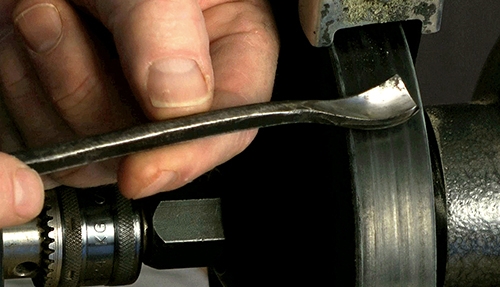
Very helpful. It was a little nerve-wracking to put the v-tool to the grinder (!) but all the steps worked. The first time sharpening a side bevel I had the same problem that others did with thinning the edge and putting a hook into it, but I tried again with a steeper angle of attack and it worked out. Thanks Chris, this'll help the lettering job go a lot more quickly, and better.
I am used to sharpening in a very similar manner, but in sharpening a friends tool I ran across something VERY Unusual! As I reached a fine edge, I got NO burr, and the edge went really thin and flakey, like flexible metal, only molecules thin. I slip-stoned the edge, had what looked like a sharp edge, first small trial cut looked good, but then the edge like disintegrated! And would not cut. I changed to a VERY short bevel, much shorter than I use on my tools, and I could get an edge that held up and cut fairly well. WHAT is going on? Is the steel in his tool the basic cause? I've never had a floppy steel edge like this before. Was I making the bevel too long for this type of steel? Maybe I've focusing on the steel too much? Do you have any ideas as to what was happening? Thanks, Charlie